
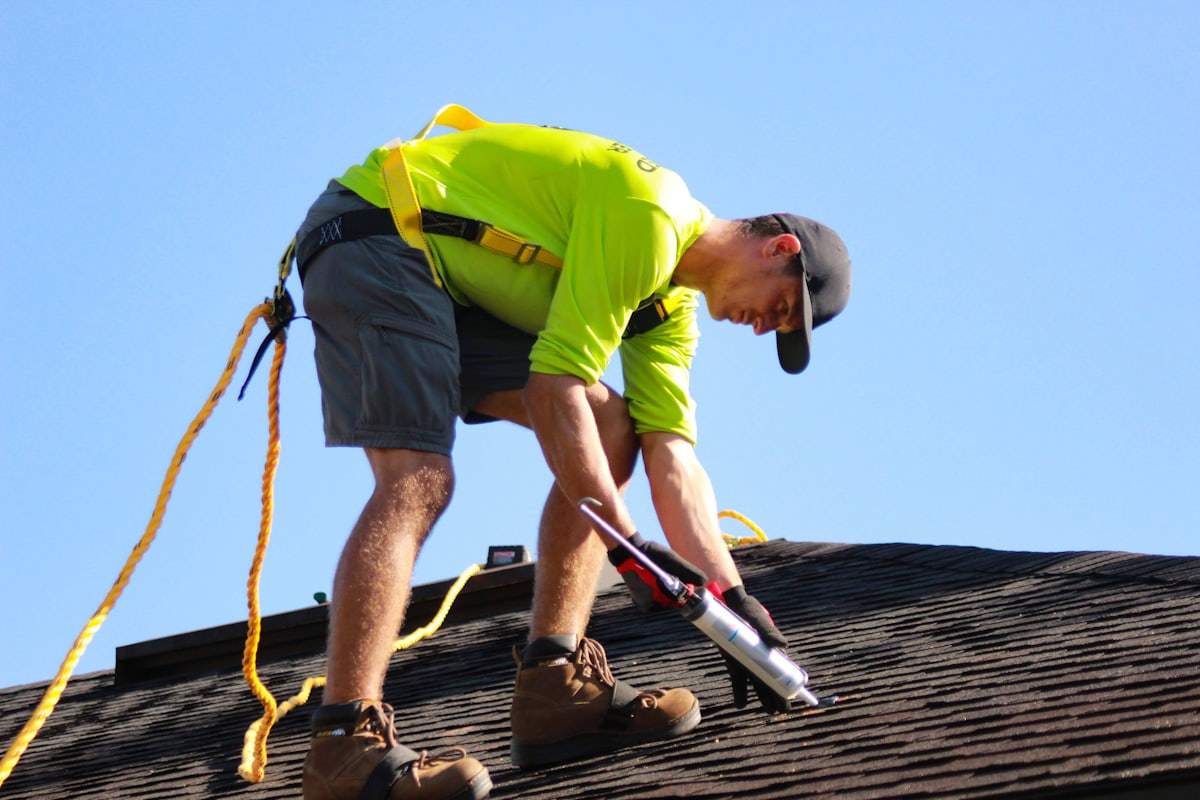
A gap the width of a pencil lead in the sealant around a pipe boot costs you nothing in July. Rain gets in, the sun bakes it back out, nobody notices. Run that same gap through a freeze and the water sitting in it turns to ice, expands, and shoves the opening wider. It thaws, soaks further into the decking, freezes again. By spring the small thing isn't small, and a brown ring on a bedroom ceiling is how most people find out.
That's the argument for looking the roof over now rather than in December. Sealant wants a warm, dry surface to bond to, and the mild afternoons are running out.
Here's the walk, sorted by where you're standing. Some of it you shouldn't be doing at all.
From the driveway
All of this is safe. Do it in the morning or late afternoon, when low sun rakes across the shingles and shows up anything that isn't lying flat.
Granules at the downspout outlet. Look for dark grit, like coarse sand mixed with coffee grounds, where the downspout discharges or in the bottom of the gutter. Every asphalt roof sheds some. What matters is whether it keeps coming, and whether the shingles above have gone darker or slick-looking in patches. Granules are the roof's sunscreen. Once they're gone the mat underneath starts drying out. Hail strips them in round bruises rather than evenly.
Lifted shingle tabs. Sight along each roof plane from a corner of the property, not straight on. You're looking for tabs standing slightly proud of the course below, or corners curled up and away. A lifted tab means the factory sealant strip bonding each shingle to the one beneath has let go. Wind gets under there and keeps working it. So does meltwater, which is the part that matters in January. The I-25 corridor through Douglas County is one of the most hail-prone stretches of the Front Range, so tabs and bare patches deserve a slow look here.
Gutters and downspouts. Sagging runs, a seam that weeps, staining down the fascia, a downspout dumping right at the foundation. All winter your gutters carry meltwater off a sun-warmed roof while the eave itself is still frozen, so anything that holds water instead of moving it becomes ice with a roof edge attached. If you do one thing before the freeze, clean and re-pitch the gutters and downspouts and move the discharge away from the house.
Tree limbs over the roof. Anything touching now, plus anything close enough to touch once it's loaded. Wet snow bends a limb much further than you'd guess looking at it dry. Limbs scour granules off the shingles underneath and drop needles into valleys, where the debris holds moisture against the roof.
Penetrations, as far as you can see them. Binoculars on the plumbing stacks, the furnace flue, the chimney, and any wall a roof plane runs into. Failed sealant looks like dried mud, broken into plates with gaps between. A rubber pipe boot splits at the top collar, or shrinks down the pipe far enough to show a ring of bare metal. Penetrations leak long before the open field of a roof does, so that's where we look first.
Granules in the gutter don't mean you need a new roof, and a hailstorm in your zip code doesn't mean you have a claim. We'd rather tell you the roof has life left and show you the photos behind that answer. We won't open a claim to go looking.
From inside the attic
Pick a bright day and give your eyes a minute up there before the headlamp comes on.
Daylight. At the ridge vent and the soffits it belongs there. Pinpoints out in the middle of the deck, along a valley, or around a single nail do not. Anything that passes light passes water.
Damp or stained sheathing. Dark rings and streaks, usually near a penetration or low on a north slope that never fully dries. Press on it. Firm means an old leak that dried out. If the sheathing gives under your thumb, the plywood or OSB has lost its glue, and that sheet gets cut out and replaced rather than roofed over.
Frost on the nail tips. On a cold morning the shanks of the roofing nails poking through the deck can be furred white. That isn't a leak. Humid air from inside the house is hitting a cold surface, which makes it a ventilation and air sealing question rather than a shingle question. It still drips. The tell is that it drips on a warm afternoon instead of during a storm.
Compressed or discolored insulation. Insulation that's flattened, or gray and dirty-looking in streaks, is insulation air has been moving through. Check the eaves in particular. If batts or blown-in have been shoved out into the soffit area, the intake vents are choked, the attic runs warmer than it should, and the snow above melts unevenly. That's how ice builds at the eave.
What takes somebody on the roof
We'd ask you not to do this part yourself. A shingle roof at seven in the morning is frosted and slick, Class 4 impact-resistant shingles are no friendlier underfoot, and anything steeper than a walkable pitch is a different job with different equipment. Most of that we do by drone.
Sealant and flashing at every penetration. Pipe boots, the counter flashing let into a chimney, step flashing where a roof plane meets a wall, the kickout flashing at the bottom of that run. Small fixes, while they're still small. Resealing a boot or swapping a cracked one is ordinary roof repair work, and it's the fix to make before a freeze cycle gets into the gap.
Valleys and the eave edge. Debris packed into a valley, and whether there's ice and water barrier under the first courses at all. On a re-roof inside the Town of Castle Rock that barrier is required, along with drip edge at the eaves and rakes, a full tear-off with no overlay, and a mid-roof inspection once the roof is dried in. A property's fire intensity classification on the Colorado Wildfire Resiliency Map can also pull state wildfire resiliency requirements into the job.
Brittleness. Shingles stiffen as they age, and a tech can feel it by lifting a tab to see whether it flexes or cracks. Cold makes that worse.
Permits are per structure, and a repair isn't automatically exempt. In unincorporated Douglas County, including Highlands Ranch, Roxborough Park, The Pinery, Stonegate, Sedalia, Franktown and Perry Park, the Douglas County Building Division in Castle Rock requires a permit once a repair covers more than one roofing square, meaning a hundred square feet, or when the roof is replaced. Asphalt for asphalt and metal for metal can usually be applied for online. Castle Rock, Parker, Lone Tree, Castle Pines and Larkspur run their own processes, so we confirm jurisdiction by address and pull the permit.
If the walk turns up one thing and you're deciding where to spend the last mild Saturday, make it the penetrations and the gutters. That's where winter water gets in. The lifted tabs, the granule loss, the question of how much roof you have left: that's what a free roof inspection is for, and finding out before the snow sits costs you nothing.